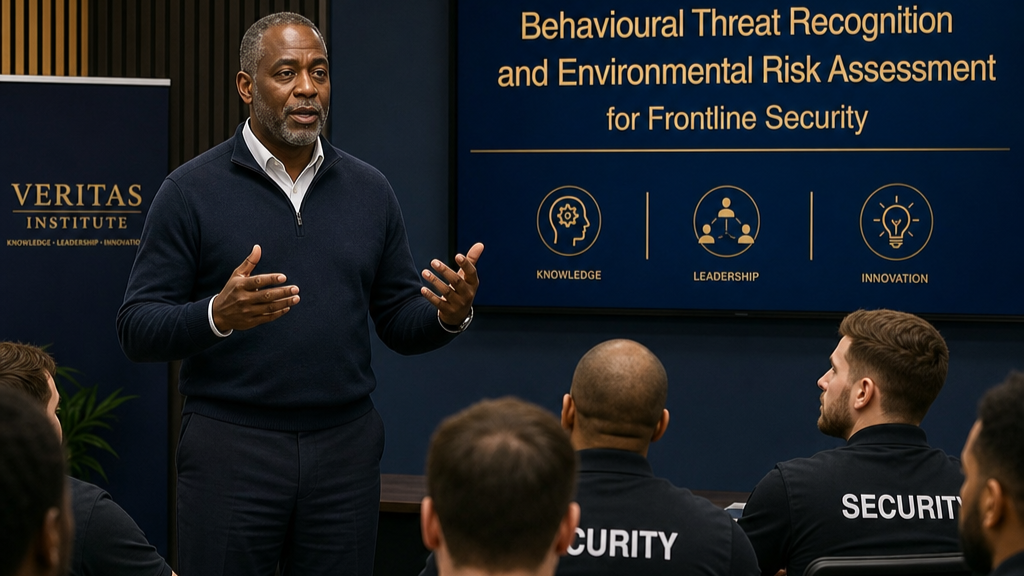
Behavioural Threat Recognition and Environmental Risk Assessment for Frontline Security
Course Overview
Modern security environments demand more than vigilance—they demand insight. This advanced program equips frontline professionals with the ability to recognize behavioural risk before violence occurs, combining global behavioural science, threat-assessment research, and real-world operational practice. Learners develop the perceptual and analytical skills to read human behaviour, interpret environmental cues, and intervene early with confidence and professionalism. Through eight structured modules, participants learn to think, observe, and act like behavioural threat-recognition specialists—transforming routine presence into proactive prevention.
Who This Course Is For
This course is designed for frontline security professionals working in dynamic, high-risk, or public-facing environments including corporate and commercial security, healthcare and hospital protection teams, retail and shopping centre operations, transit and transportation hubs, government and public-service facilities, hospitality, event and venue security, education and campus safety, and industrial or critical-infrastructure sites. Whether new to the field or experienced in operations, learners gain advanced behavioural insight to elevate their protective capability.
Learner Outcomes
Upon completion, participants will be able to identify behavioural baselines and detect anomalies in any environment, recognize pre-incident indicators and violence precursors, read human behaviour in real time using validated behavioural cues, conduct dynamic environmental scanning and risk assessment, intervene early using calm, professional communication, de-escalate emotional escalation and disrupt harmful intent, respond effectively and document incidents with clarity and defensibility, and contribute to a proactive, intelligence-driven safety culture.
This is not traditional security training. This is modern, evidence-based behavioural threat recognition.