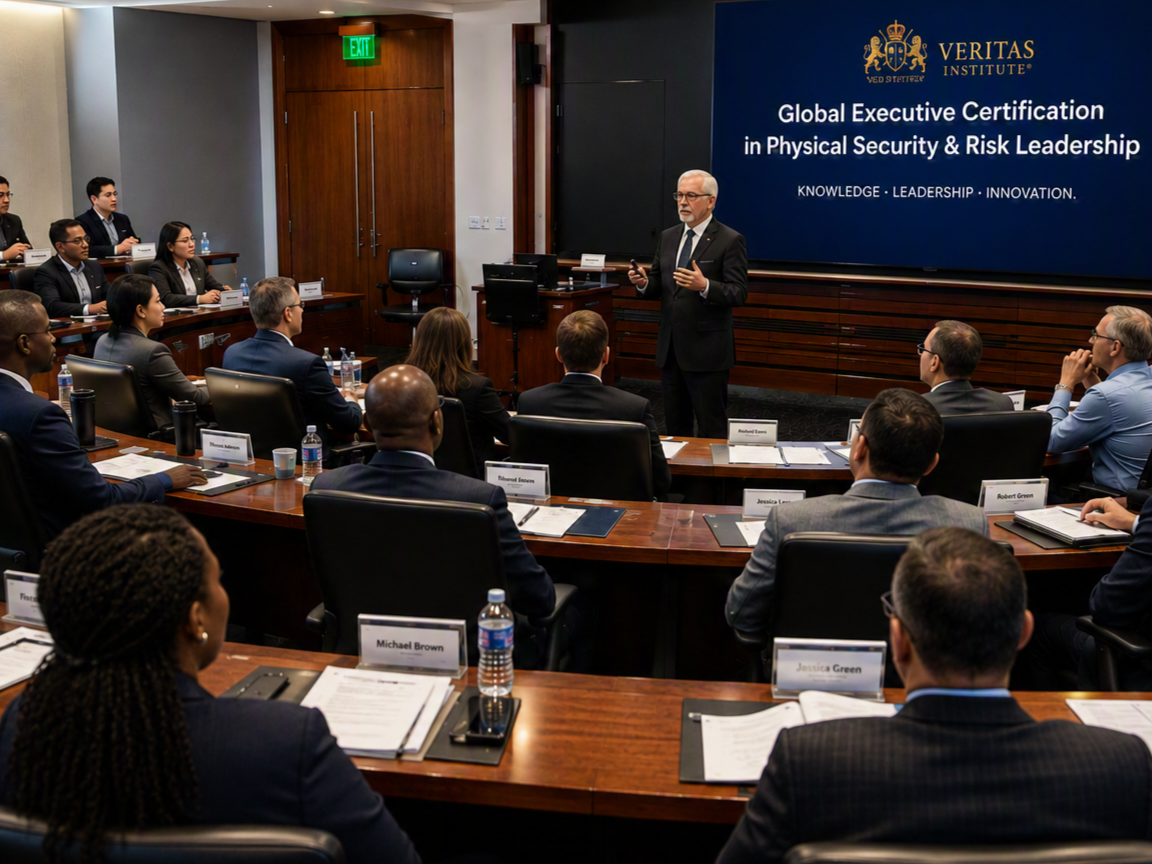
Global Executive Certification in Physical Security and Risk Leadership
A Director‑Level Credential for Modern Security, Risk, and Resilience Executives
Course Overview
This certification was developed by Veritas Institute’s security subject matter experts, faculty, and advisory council through rigorous collaboration with senior security leaders across Fortune 500 enterprises, government agencies, critical infrastructure sectors, and international security organizations. The curriculum integrates standards and methodologies from the FBI, DHS, Secret Service, RCMP, Interpol, CISA, NIST, ISO, and leading global corporations—ensuring every module reflects real-world executive practice, validated frameworks, and globally recognized security leadership principles.
This certification reflects the realities of modern threat environments—cyber-physical convergence, insider risk, geopolitical instability, violent intrusion, operational disruption, and emerging technologies such as autonomous systems and AI-driven surveillance. Every module is informed by real-world case studies from 2014–2025, including incidents in North America, Europe, Asia-Pacific, and the Middle East. These cases were selected because they represent the most consequential failures and breakthroughs in contemporary security leadership.
This is not an operational training course—it is an executive-level leadership certification designed to elevate practitioners into strategic decision-makers capable of influencing organizational direction, shaping resilience, and governing enterprise risk at scale.
Who This Certification Is For
This program is designed for professionals who operate—or aspire to operate—at the director, senior manager, or executive level within security, risk, resilience, or protective services.
Ideal Candidates Include:
Security Leadership
- Directors of Security
- Chiefs of Security / CSO-Track Professionals
- Global Security Operations Leaders
- Protective Services and Executive Protection Managers
Risk and Resilience Executives
- Directors of Risk
- Business Continuity and Crisis Management Leaders
- Enterprise Resilience Managers
- Operational Risk Leaders
Corporate and Operational Leadership
- Directors of Operations
- Facility and Infrastructure Leaders
- Compliance Executives
- Senior Managers overseeing cross-functional risk
Government, Critical Infrastructure, and Public Sector
- Emergency Management Directors
- Public Safety Leaders
- Intelligence and Protective Detail Supervisors
- Critical Infrastructure Security Managers
If your role requires executive communication, enterprise governance, strategic decision-making, or cross-functional leadership, this certification is built for you.
Learner Outcomes
Graduates of the Global Executive Certification in Physical Security and Risk Leadership emerge with executive-level capability, able to lead security as a strategic business function rather than an operational department.
Lead Security at the Executive Level
- Govern enterprise risk with clarity, structure, and authority
- Influence C-suite decision-making through business-aligned communication
- Translate complex threats into actionable executive insights
Build Enterprise-Wide Resilience
- Design multi-year resilience and continuity roadmaps
- Conduct stress tests and organizational readiness assessments
- Integrate crisis management, continuity, and physical security architecture
Govern Cross-Functional Security Programs
- Lead enterprise risk committees and security governance councils
- Align security with HR, IT, legal, compliance, and operations
- Build unified cyber-physical governance frameworks
Manage High-Impact Crisis Events
- Establish unified command structures
- Deliver authoritative executive communication during crises
- Guide enterprise recovery, stabilization, and post-incident transformation
Architect Modern Physical Security Infrastructure
- Design layered physical security systems and hardened facilities
- Govern protective services and executive protection programs
- Implement modern surveillance, access control, and protective technologies
Anticipate Emerging Threats
- Interpret global risk trends and geopolitical shifts
- Integrate innovation responsibly (AI, autonomous systems, drone mitigation)
- Prepare organizations for future cyber-physical threat vectors
Demonstrate Director-Level Competency
- Build and apply security maturity models
- Lead enterprise transformation and cultural adoption
- Strengthen organizational security posture through governance and influence