Operational Security Leadership in High-Risk Environments

Course Overview
In an era defined by volatility, geopolitical tension, cyber‑physical disruption, and rapidly evolving threat actors, organizations need leaders who can operate with clarity, confidence, and precision in the world’s most challenging environments. This advanced program delivers a fully integrated, applied operational security framework built on global best practices, intelligence‑community methodology, law enforcement doctrine, emergency management science, and real‑world fieldcraft.
Developed by the Veritas Institute — a leader in global security education and professional development — this course is grounded in internationally recognized standards including ISO 31000 (Risk Management), ISO 22301 (Business Continuity), and ISO 27001 (Information Security). Learners gain access to a curriculum shaped by operational experts, former law enforcement professionals, crisis leaders, and intelligence practitioners who have worked in high‑risk jurisdictions around the world.
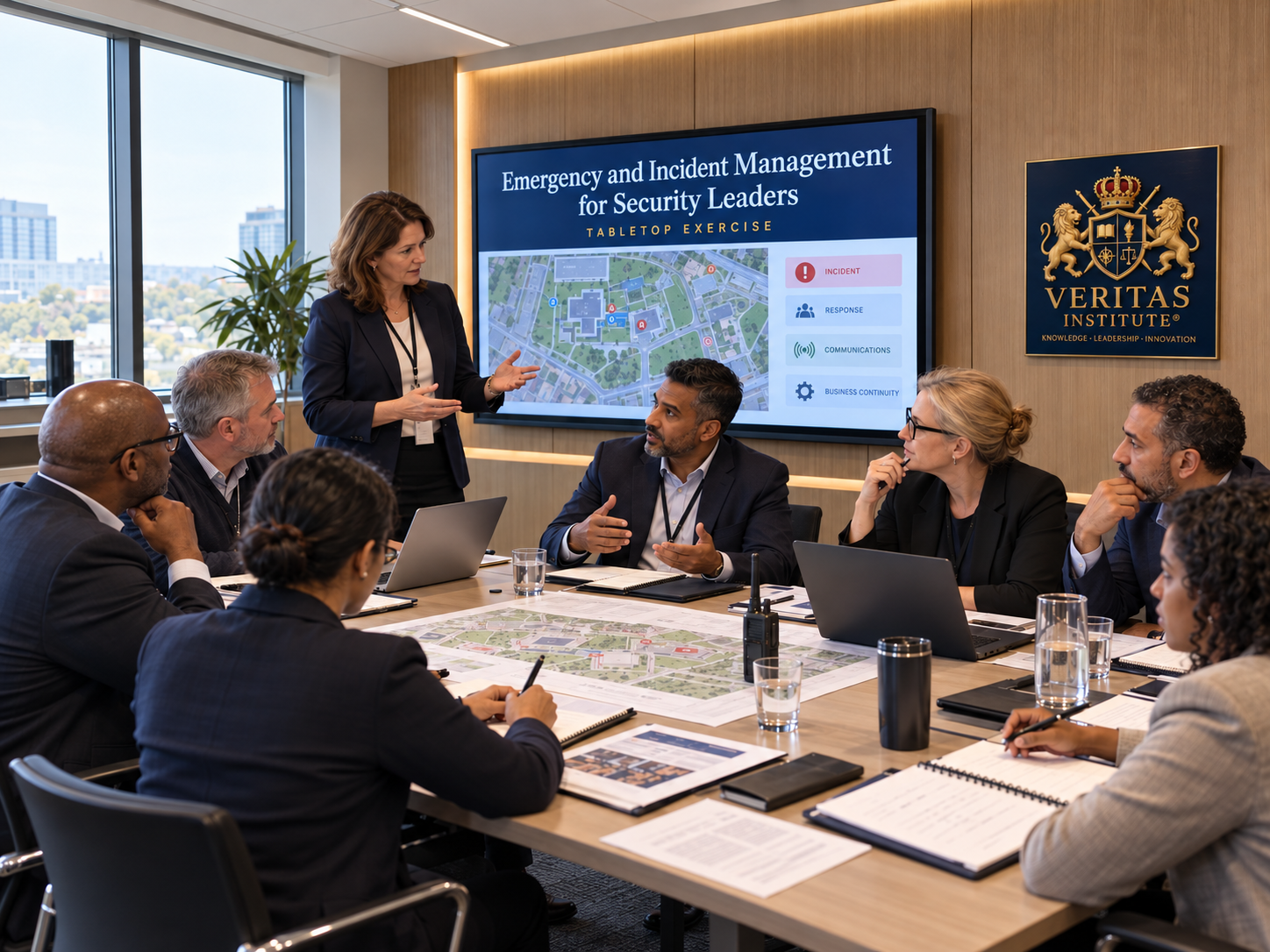
This is not a theoretical program. Every module is designed for immediate workplace application, blending scenario‑based learning, field simulations, and decision‑making exercises that mirror real operational pressures. Graduates emerge with the capability to lead teams, protect assets, manage crises, and make informed decisions in environments where uncertainty is constant and consequences are severe.
This course represents the new benchmark for modern operational security leadership — credible, rigorous, and globally aligned.
Who Is This For
This program is designed for professionals who operate, lead, or support security‑critical functions in complex or high‑risk environments. It is ideal for:
-
Security managers, directors, and executives responsible for organizational protection
-
Corporate leaders overseeing operations in unstable or emerging markets
-
Law enforcement professionals transitioning into private or corporate security roles
-
Emergency management and crisis response personnel
-
Intelligence analysts, risk practitioners, and protective operations specialists
-
Military veterans entering civilian security leadership positions
-
Professionals seeking to elevate their credentials with a globally credible, applied security designation
Whether you manage a corporate facility, oversee field operations, lead protective teams, or support organizational resilience, this course equips you with the applied leadership skills required to operate effectively when conditions deteriorate and decisions matter most.
Learner’s Outcome
Graduates of this program leave with a fully integrated operational security leadership capability — not just knowledge, but practical skill. Upon completion, learners will be able to:
-
Conduct structured threat assessments and make informed decisions under pressure
-
Integrate intelligence, risk management, crisis leadership, and fieldcraft into a unified operational approach
-
Lead protective operations, manage high‑risk movements, and safeguard personnel in volatile environments
-
Apply behavioral threat analysis to identify early indicators of escalation or harmful intent
-
Navigate complex field environments using real‑world operational techniques and situational awareness
-
Build resilient teams capable of performing under stress, uncertainty, and operational fatigue
-
Communicate clearly and confidently with executives, stakeholders, and cross‑functional partners
-
Develop and implement operational plans aligned with global standards and best practices
-
Strengthen organizational governance, security culture, and ethical decision‑making
-
Operate with professional credibility, strategic clarity, and global‑grade competence
Learners finish the program with the confidence and capability to lead in environments where traditional security training is insufficient — equipped with a modern, applied, and internationally credible operational security framework.