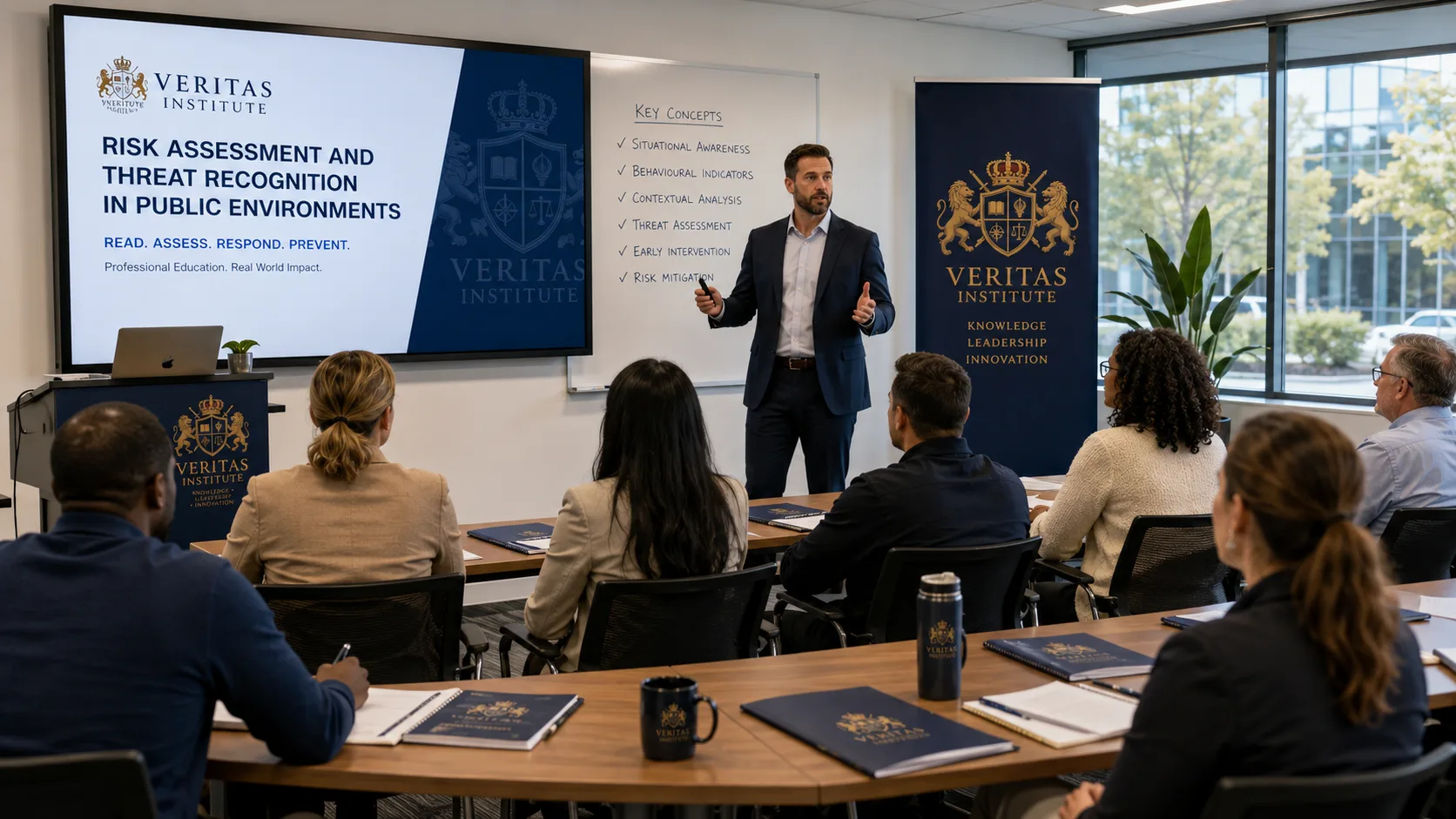
Risk Assessment and Threat Recognition in Public Environments
Course Overview
Public-facing security work has entered a new era. Environments are more fluid, more crowded, and more behaviorally complex than ever before. Threats rarely announce themselves—they surface quietly through subtle cues, contextual anomalies, and behavioural deviations that only trained professionals can detect.
This program is built for that reality. It delivers a modern, research-driven framework for reading environments, interpreting behaviour, identifying pre-incident indicators, and managing emerging risk with clarity and precision. Developed by board-certified subject matter experts, the course integrates leading methodologies used across Canada and the United States, including ISO 31000, the RCMP Harmonized Threat and Risk Assessment model, DHS THIRA, NTAC behavioural threat assessment research, and best practices from emergency management and protective intelligence.
Learners gain a deep understanding of how risk forms, how it evolves, and how to recognize it early—long before escalation. You will learn to distinguish normal behaviour from contextual behaviour, anomalies from concerning patterns, and early indicators from imminent threats. This is not theoretical training; it is operational, practical, and designed to elevate real-world performance in dynamic public environments.
Who This Course Is For
This certification is designed for professionals who operate in environments where vigilance, judgment, and behavioural interpretation are essential. It is ideal for:
- Transit security and public transportation systems
- Corporate security teams and facility protection
- Healthcare security and patient-facing environments
- Retail, shopping centres, and high-traffic commercial spaces
- Hospitality, tourism, and guest-service environments
- Public events, festivals, and crowd-management operations
- Government buildings and public-service facilities
- Critical infrastructure and essential service sites
- Campus, institutional, and educational security
If your role requires you to read people, interpret context, and make decisions under pressure, this course strengthens your capability to a professional, board-certified standard.
Learner Outcomes
Graduates of this program emerge with a refined, disciplined, and operationally grounded threat-recognition capability. By the end of the course, learners will be able to:
- Recognize early behavioural indicators of risk, crisis, or escalation
- Interpret environmental context and identify anomalies with precision
- Apply structured threat-recognition models used across public safety agencies
- Understand lone-actor pathways, concealed-threat indicators, and crowd dynamics
- Assess situations quickly and respond with clarity under pressure
- Strengthen situational awareness, observational discipline, and professional judgment
- Contribute proactively to incident prevention, public safety, and organizational resilience
This course builds a mindset—one that is proactive, analytical, and grounded in evidence-based practice. It prepares professionals to see what others miss, act before situations escalate, and operate confidently in environments where uncertainty is constant.