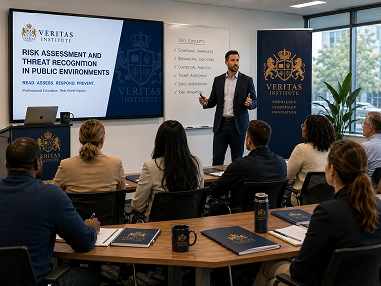
Risk Assessment and Threat Recognition for Public Environments
“Risk isn’t just something you react to — it’s something you learn to see coming.”
Risk Assessment and Threat Recognition in Public Environments gives security professionals a structured, modern framework for reading risk in real time, making sound decisions under pressure, and acting with professionalism in complex public settings.
Designed for frontline and supervisory personnel, this course moves beyond intuition and “gut feeling” toward disciplined, defensible practice. You’ll learn how to interpret context, distinguish hazards from threats, recognize pre-incident indicators, and apply proportional, ethical responses in dynamic environments such as transit hubs, malls, festivals, hospitals, and corporate sites.
By the end of this course, you won’t just be present in the environment—you’ll be actively shaping it for safety.
What learners gain
- A clear operational risk mindset A practical understanding of likelihood, impact, and vulnerability in public and open environments.
- Sharp observational and reporting skills The ability to separate observation from interpretation and produce clear, defensible, professional reports.
- Baseline and anomaly recognition Confidence in reading behavioural and environmental baselines, spotting anomalies, and identifying pre-incident indicators early.
- Structured threat recognition tools Exposure to behavioural threat assessment, lone-actor pathways, insider risk, social engineering, and exploitation indicators.
- Stronger decision-making under pressure Techniques for structured incident management, emergency decision-making, and one-page tactical planning in real-world conditions.
- Ethical, proportional, and transparent practice A grounded approach to authority, bias awareness, technology governance, and public trust in visible security roles.
- Integrated, end-to-end risk cycle competence From initial observation and environmental scanning through intervention, after-action learning, and continuous improvement.
Designed for frontline security teams, loss prevention professionals, retail managers, and corporate investigators, this program blends criminological research with operational doctrine, behavioral analysis, and real-world scenario immersion. Learners move beyond policy awareness into true operational readiness—gaining the confidence to detect, disrupt, and respond to organized theft networks, violent incidents, and complex multi-agency investigations.
By the end of this program, learners won’t just understand organized retail crime. They’ll be ready to suppress it.
Who this course is for
Ideal for professionals responsible for retail safety, asset protection, and organized theft response, including:
Security officers and supervisors:
Frontline responders who must identify pre-incident indicators, deter organized theft groups, and make rapid decisions during evolving incidents.
Loss prevention and asset protection teams:
Specialists responsible for investigations, surveillance, pattern recognition, and intelligence gathering across multiple store locations.
Retail managers and corporate security leaders:
Professionals accountable for operational readiness, staff safety, crisis response, and coordination with law enforcement partners.
ORC investigators and analysts:
Those tasked with tracking booster crews, identifying fencing operations, and supporting multi-jurisdictional investigations.
Contracted security providers in retail environments:
Third-party security teams operating in malls, big-box stores, luxury retail, pharmacies, and high-risk commercial environments.
What learners gain
A comprehensive, operations-ready foundation for retail crime suppression and ORC response:
- Clarity on the modern retail threat landscape
Understand how economics, technology, social change, and global criminal networks shape today’s retail crime environment—from booster crews and flash-mob thefts to cyber-enabled fraud and cross-border fencing operations.
- Mastery of offender tactics and behavioral indicators
Learn how organized theft groups plan, coordinate, and execute operations—and how to identify pre-incident indicators, suspicious behaviors, and coordinated group activity.
- Operational situational awareness and frontline readiness
Develop the ability to detect anomalies, read environments, and maintain awareness under stress, fatigue, and high-traffic conditions.
- Safe and effective incident response
Strengthen decision-making during theft incidents, violent confrontations, and high-risk events—balancing safety, legality, and operational discipline.
- Intelligence gathering and ORC investigation skills
Support investigations through accurate reporting, evidence preservation, pattern recognition, and collaboration with law enforcement and ORC task forces.
- Crisis communication and coordinated response capability
Communicate clearly during chaotic events—providing timely, accurate, and actionable information to staff, customers, and external partners.
- Technology and innovation fluency
Understand how AI, RFID, analytics, and digital forensics are reshaping both retail crime and modern security operations.
- Multi-agency collaboration skills
Work effectively with police, regional ORC units, and cross-jurisdictional partners using shared terminology, investigative alignment, and coordinated strategies.
- Post-incident recovery and organizational resilience
Support staff and operations after critical events—balancing psychological safety, communication, continuity, and reputational considerations.
- Confidence to lead during full-scale ORC events
Apply all concepts in a capstone simulation that mirrors a real organized theft incident, reinforcing decision-making, coordination, and leadership under pressure.