Fire Control Systems and Life Safety Operations
Course Overview
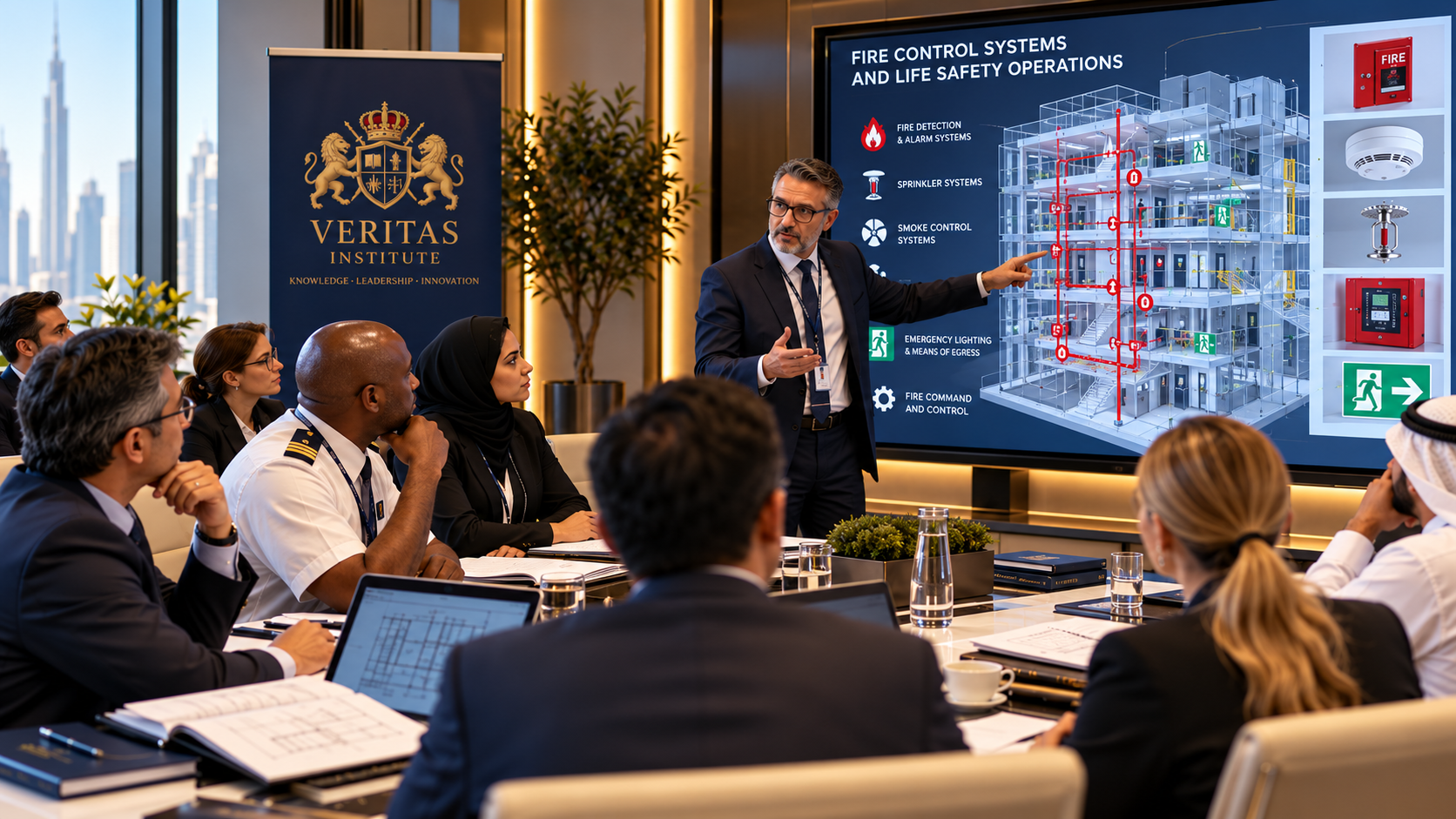
Fire‑life‑safety in modern facilities is no longer a narrow technical discipline; it is a complex, integrated operational ecosystem that determines whether organizations remain safe, resilient, and mission‑ready. This comprehensive course guides learners through the full lifecycle of fire events—from early detection and suppression to compartmentation, smoke control, emergency coordination, post‑incident recovery, and long‑term resilience. Designed with real‑world environments in mind, the curriculum reflects the operational realities of healthcare facilities, mixed‑use buildings, critical infrastructure sites, and contract security operations.
Across seven modules, learners develop a deep understanding of how systems behave, how people respond, and how leadership shapes outcomes. The course moves beyond technical knowledge and into strategic capability, showing how integrated planning, organizational culture, and cross‑department coordination transform fire‑life‑safety from a compliance requirement into a core organizational strength. By the end, participants are equipped not only to understand fire protection systems, but to lead them—ensuring their facilities remain safe, stable, and resilient under pressure.
Who Is This For
This course is built for professionals who operate in environments where fire‑life‑safety is mission‑critical and where operational decisions carry significant consequences. It is ideal for individuals responsible for safety, security, continuity, and facility operations across diverse sectors.
It is designed for healthcare administrators, clinical leaders, and facility managers who must protect vulnerable patient populations and maintain clinical continuity during emergencies. It supports property managers, building operators, and security leaders in mixed‑use environments who must coordinate diverse occupant groups and maintain safe egress under dynamic conditions. It is essential for critical infrastructure operators, industrial supervisors, and continuity managers who must safeguard mission‑critical systems and prevent cascading failures. It is equally suited for contract security professionals who serve as the frontline interface between building systems, occupants, and emergency responders.
Whether the learner is an emerging practitioner or an experienced leader, this course provides the depth, structure, and strategic perspective required to elevate their capabilities and strengthen organizational resilience.
Learners Outcome
By the end of this course, learners emerge with a fully integrated understanding of fire‑life‑safety and the ability to apply that knowledge across complex environments. They gain mastery of detection technologies, suppression systems, compartmentation strategies, smoke control behavior, and evacuation dynamics. They learn how incident command functions inside real buildings, how emergency coordination shapes outcomes, and how post‑incident recovery restores operational stability.
Learners develop the ability to interpret system behavior, anticipate fire progression, and make informed tactical decisions under pressure. They understand how to protect egress routes, support responder operations, and maintain continuity in mission‑critical environments. They gain insight into organizational culture, leadership influence, and cross‑department integration, enabling them to transform fire‑life‑safety from a technical requirement into a strategic capability.
Most importantly, learners leave with the confidence and competence to lead. They can design, evaluate, and optimize life‑safety programs; coordinate multi‑system response; strengthen organizational readiness; and build long‑term resilience. The course equips them not only to respond effectively to fire events, but to shape safer, stronger, and more resilient organizations.